Automotive Design
Ferrari Argento
Silver. Nothing else.
A bullet has no opinion about the room it is fired into. It has no allegiance to the colour scheme, no interest in the conversation, no desire to be admired. It exists for the line between two points, and it has been refined, over the long centuries of its development, into the most efficient possible expression of that line. It is also, almost incidentally, beautiful. We set out to design that. Design vision, by the studio.
I. The Premise
There was a meeting, early, in which someone said the word restraint, and someone else said no, less than restraint. Restraint implies a thing being held back. We did not want a held-back Ferrari. We wanted a Ferrari with nothing to hold back, because nothing surplus had been put in.
This is a different design instruction. It is the instruction given to a gunsmith, to a watch movement engineer, to a maker of surgical instruments. Remove until removal would break the function. Then stop, and finish what remains to a standard that does not require apology.
The Argento is the result. It is not a minimal Ferrari. Minimalism is a style. The Argento is a Ferrari with nothing extra, which is not the same thing. A style can be imitated. A discipline cannot.
II. The Name
We argued about it for nine weeks.
Every argument ended in the same place: any name we added to the car would be a name the car did not need. The badge was already Ferrari. The colour was already silver. To call the car after a city, a wind, a horse, a saint, a road, a racing victory, was to perform a meaning on top of an object that already meant something complete.
So we named it Argento. Silver. The colour, said in Italian, with no adjective in front of it and no number behind it. The most arrogant name we have ever given a car, and the most honest. A black turtleneck does not introduce itself. The Argento does not introduce itself.
III. The Body
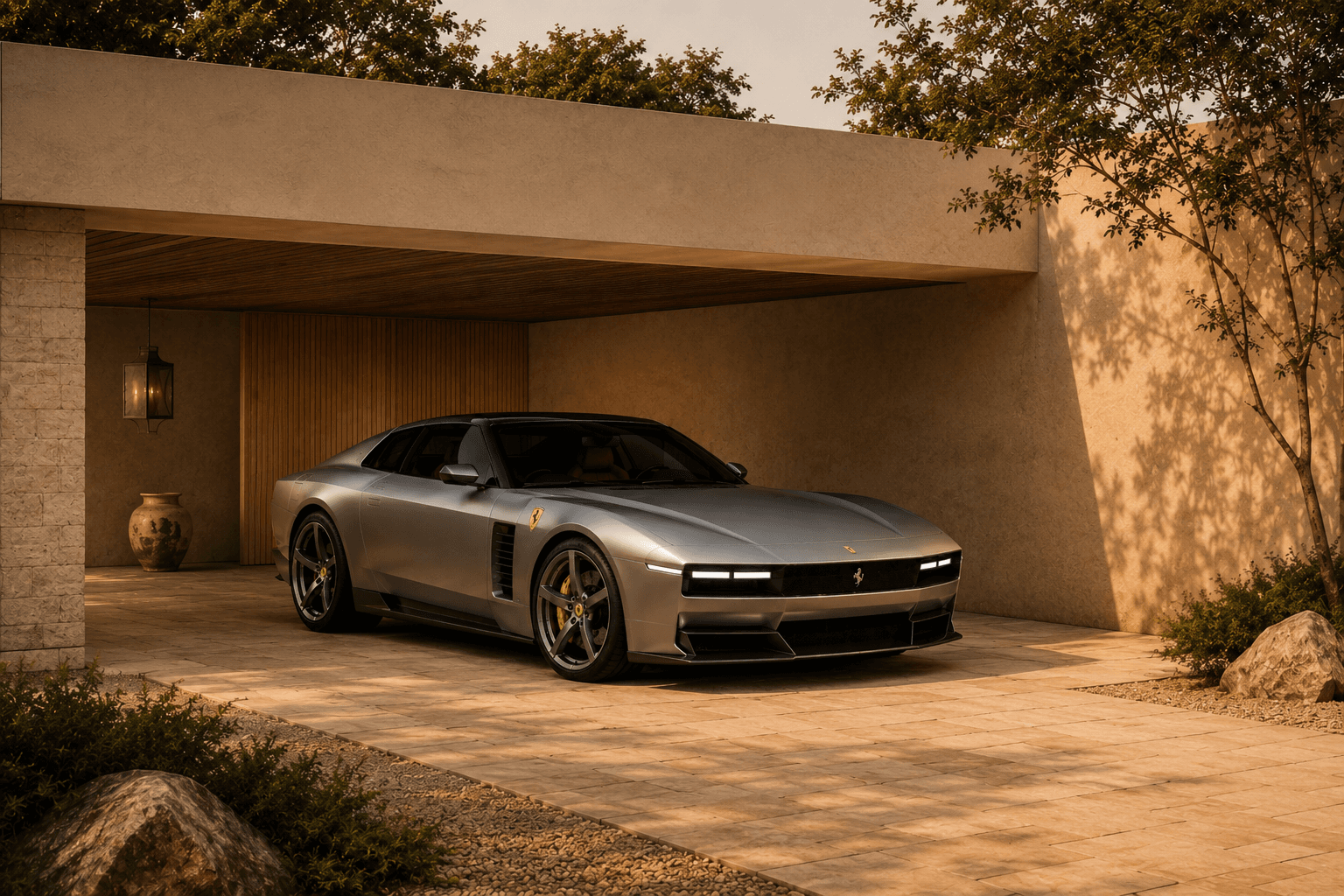
A single colour. Argento Crudo — raw silver.
We developed it by removing. The base coat was specified at the minimum legally roadworthy thickness. The clear coat was specified at the minimum that would survive a decade of European weather. No pearl flake, no metallic suspension dramatised for the showroom turntable, no soft-focus pigment intended to flatter a magazine photograph. The body is the colour of the metal that lies beneath it. The paint exists to prevent corrosion. Anything more would be costume.
The result is a finish that does not perform under light. It receives light the way a stone receives it — evenly, without flash, without flatter. In a parking garage at noon it looks like a tool. In a tunnel at midnight it disappears. In rain it goes the colour of a held breath. We are aware that we have built a car whose paint is best appreciated in conditions where most cars cannot be seen at all. This is intentional.
IV. The Silhouette
A long bonnet. A short tail. A roofline that is one continuous arc from windshield to rear glass, with no break, no shoulder, no signature kink for the brand recognition team. The cabin is set back. The front overhang is shorter than the rear. From a hundred metres the car reads as a single drawn line, slightly tapered at the back, with two wheels visible.
This is the silhouette of a projectile. We did not arrive at it by mimicking projectiles. We arrived at it by removing every surface that did not serve the line.
The flanks are unbroken. There is no character line stamped down the door. There is no scallop in the rear haunch. There is no surface change to suggest motion to a stationary viewer. The car is not selling motion. The car is reserving motion for the moment it actually moves. Until then, it stands still, completely still, like a man in a suit who is not gesturing.
V. The Face
One horizontal aperture across the front. One.
Inside that aperture, two slim headlamps, machined as slots. No daytime running signature shaped to look like a face. No grille, in the operatic Ferrari sense — the airflow is managed below the cut-line, where the eye does not search for it. The prancing horse is small, centred, milled from solid metal, not painted, not chromed.
There is no expression. The Argento does not greet. It does not threaten. It does not perform identity at you. It registers your presence the way a Walther registers a hand — with a weight and a temperature, and otherwise without comment.
VI. The Rear
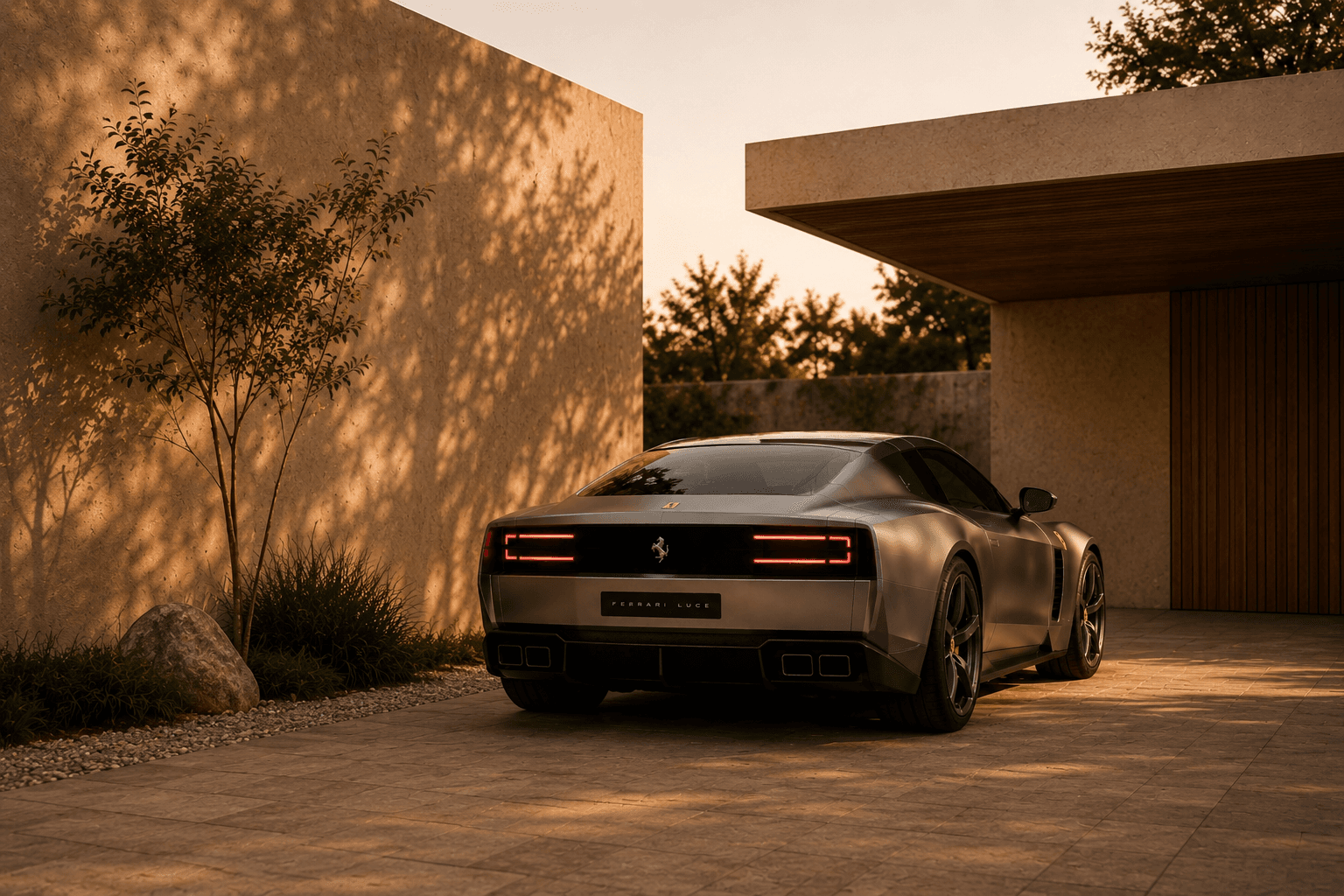
The signature is light, and only light.
Two horizontal bars, cut full-width across the tail, illuminated in a single uninterrupted red. They are not stylised. They are not given a flourish at the corners. They are a line, and then another line, and between them the badge, and beneath them the panel that contains the exhausts. The exhaust tips are two ovals, set wide, machined from raw titanium that will blue with heat and remain blued. We will not polish them at service. The car ages, and the rear of the car is where the ageing is allowed to show.
The diffuser is functional. The dimensions of it were given to us by the aerodynamics team and were not subsequently revised for visual effect. We accepted the geometry that the air required. This is, in our view, the only honest way to design the underside of a fast car.
VII. The Cabin
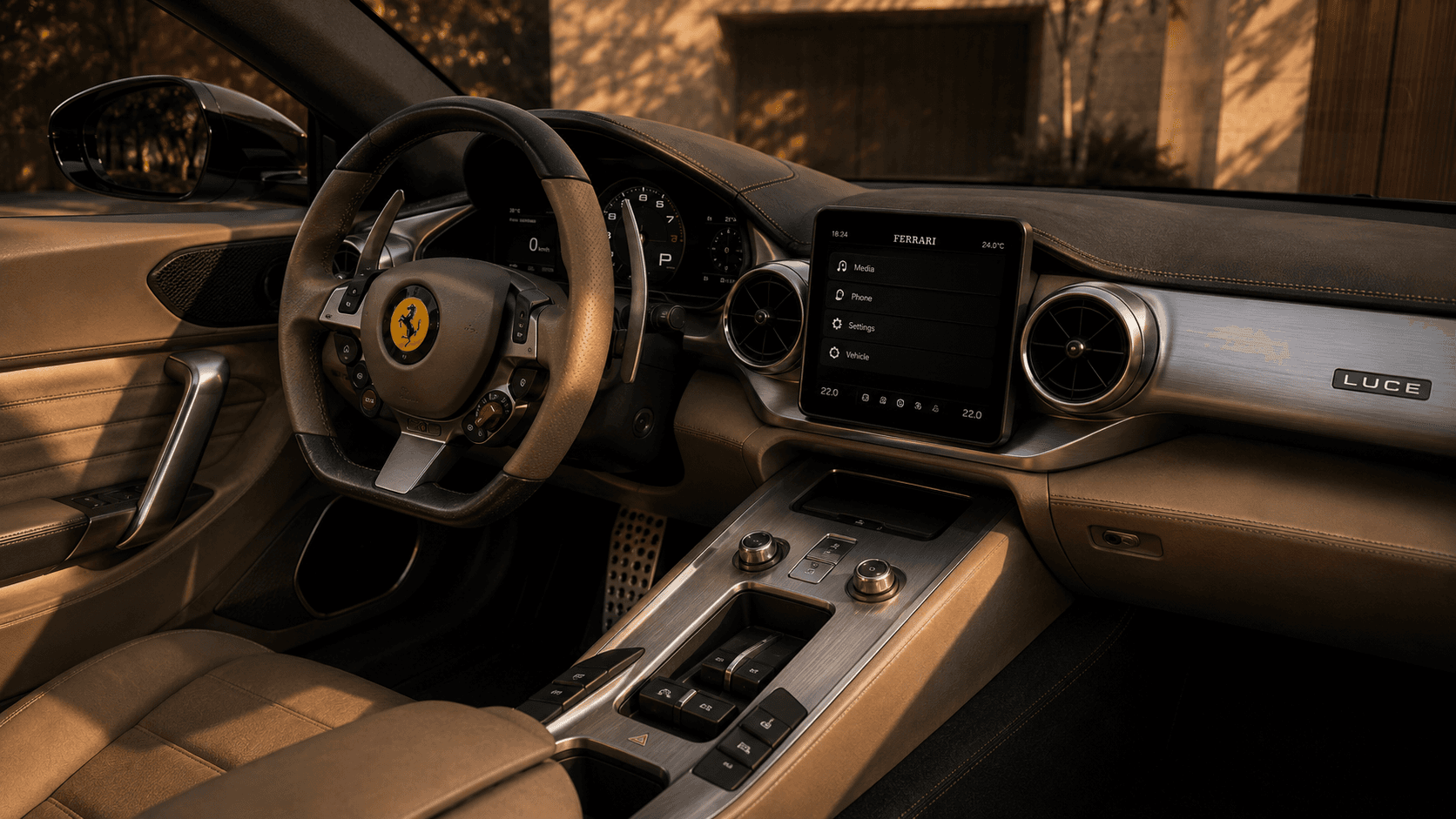
Black. Wool. Brushed steel. Three round dials. One screen, the smallest screen we could install while still meeting regulation. One steering wheel, leather, no contrast stitching, no flat bottom, round the way a steering wheel was round in 1962 because a circle is the correct shape for the task.
The shift paddles are turned aluminium, cold to the first touch. The seats are wool over a thin foam over a carbon shell, because wool is the material a serious person wears in a serious situation and we saw no reason to dress the driver in upholstery he would not wear himself. There is no quilting. There is no diamond stitch. There is no piped contrast trim arranged to suggest luxury. The luxury is the absence.
The dashboard is a single horizontal plane, matte. Three instruments are cut into it — speed, revolutions, time. Nothing else lives on the centreline. The climate controls are two physical dials, knurled, machined, set into the console where the hand finds them without looking. We have removed every menu, every submenu, every haptic surface that requires the eye to leave the road. The driver of an Argento does not negotiate with the car. The driver of an Argento uses the car.
VIII. The Sound
We considered, for one afternoon, the possibility of synthesised augmentation in the cabin. We did not consider it for two afternoons.
The engine makes the sound the engine makes. The exhaust is tuned for the exhaust note that combustion of a Ferrari V12 in titanium pipes actually produces, and not for the note that a focus group prefers. The cabin is insulated against road noise to the standard required for conversation at speed, and not beyond it. A driver who buys an Argento has bought, among other things, the right to hear the machine he is operating. We will not muffle it on his behalf.
IX. The Idea Underneath
There is a sentence we kept returning to, taped above the modelling buck for the eighteen months of the project. It read:
The most modern object is not the one that looks most like the future. It is the one that looks most like it was made.
The Argento is made. Every panel is cut. Every edge is finished. Every fastener is specified, sourced, and torqued to a tolerance that we can show you on paper. Nothing on this car is suggested. Nothing on this car is implied. The car is a series of decisions, each one of which we are prepared to defend, each one of which we have made on the side of removal.
This is, we believe, the only honourable way to design a fast car in this decade. The era of the car as theatre is closing. The car as instrument is opening. The Argento is our entry into the second era. It is a Ferrari without ornament, without ceremony, without the small performances of identity that the industry has spent forty years accruing.
It is silver, it is a bullet, it has already left the barrel by the time you finish saying its name.
X. The Name, Again
Argento.
Nothing in front of it. Nothing behind it. No suffix, no number, no Roman numeral, no anniversary mark.
If we make a faster one, it will be called Argento. If we make a lighter one, it will be called Argento. If we make a track-only one, it will be called Argento, and the buyer who knows will know which one he is buying by the serial number on the chassis plate and the weight of the door when it closes.
A car this disciplined does not need a second word.
— the studio