Object Design
Two Flames
"The two were lit so that, between them, a third thing might be seen." A Mesoamerican object study from Tulum. Twin candle cavities, bilateral light, and the carved face as corpus callosum.
I. The white hour
There is a particular hour in Tulum, late in the afternoon, when the light coming off the limestone road takes on the colour of old paper. Dust hangs in the air the way dust hangs only in places where the sea is close — heavy, slightly luminous, refusing to settle. I walked through that hour and into a small shop with a roof of dried palm and a floor of the same pale stone that, ten kilometres south, becomes the cliff over the Caribbean.
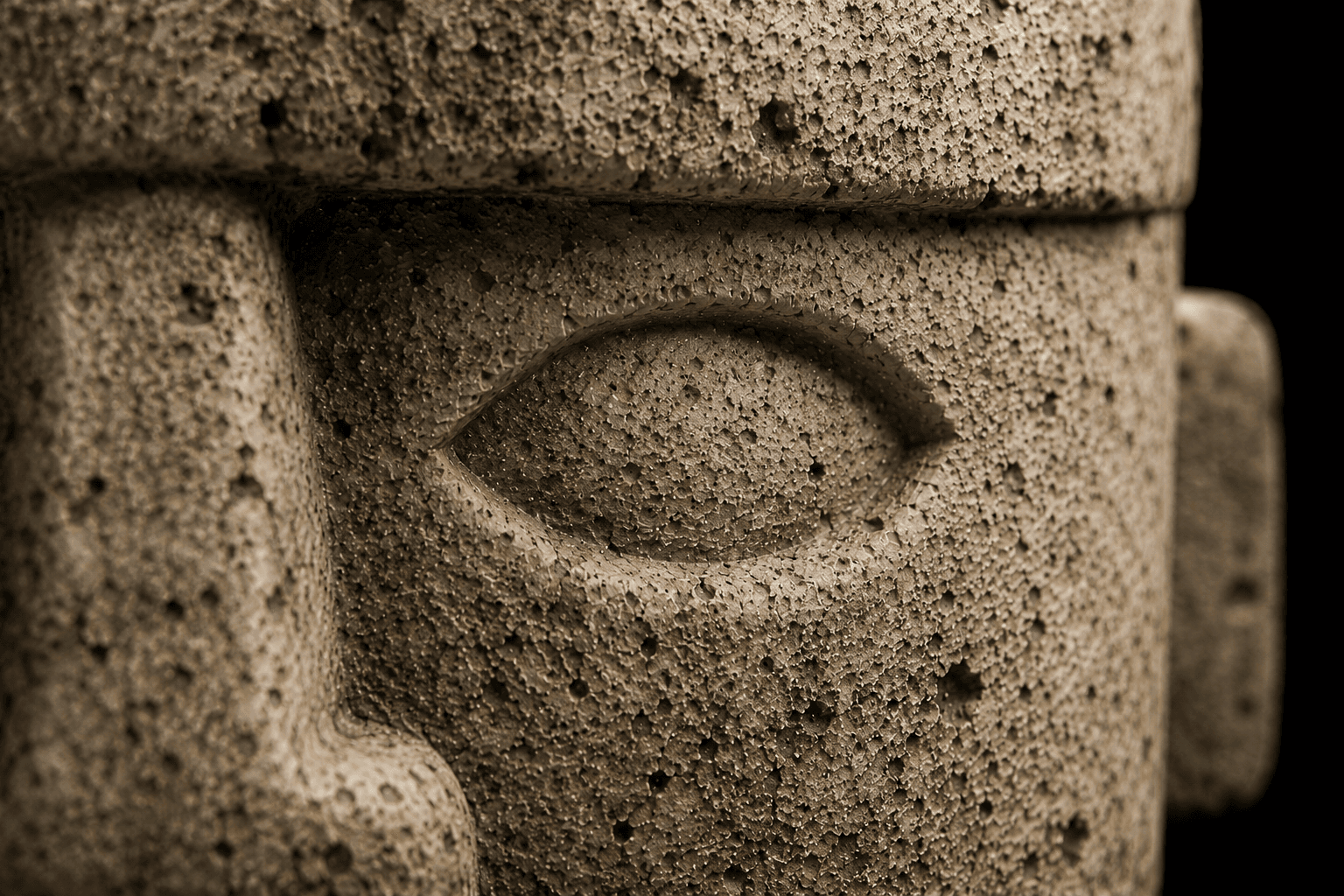
Everything in the Yucatán is made of one substance. The cenote you bathe in, the pyramid you climb, the wall of your hotel, the small carved face waiting on a low wooden table — all of them are the seabed of a vanished ocean, lifted into the air and shaped by patient hands. There is no separation here between geology and craft. The land is the material. The artisan does not bring stone from elsewhere; he uncovers what was already there, releases the figure the limestone was already holding.
I picked the object up without intending to buy anything. It fit my palm the way a heart fits the chest: as if the size had been measured in advance.
II. The face
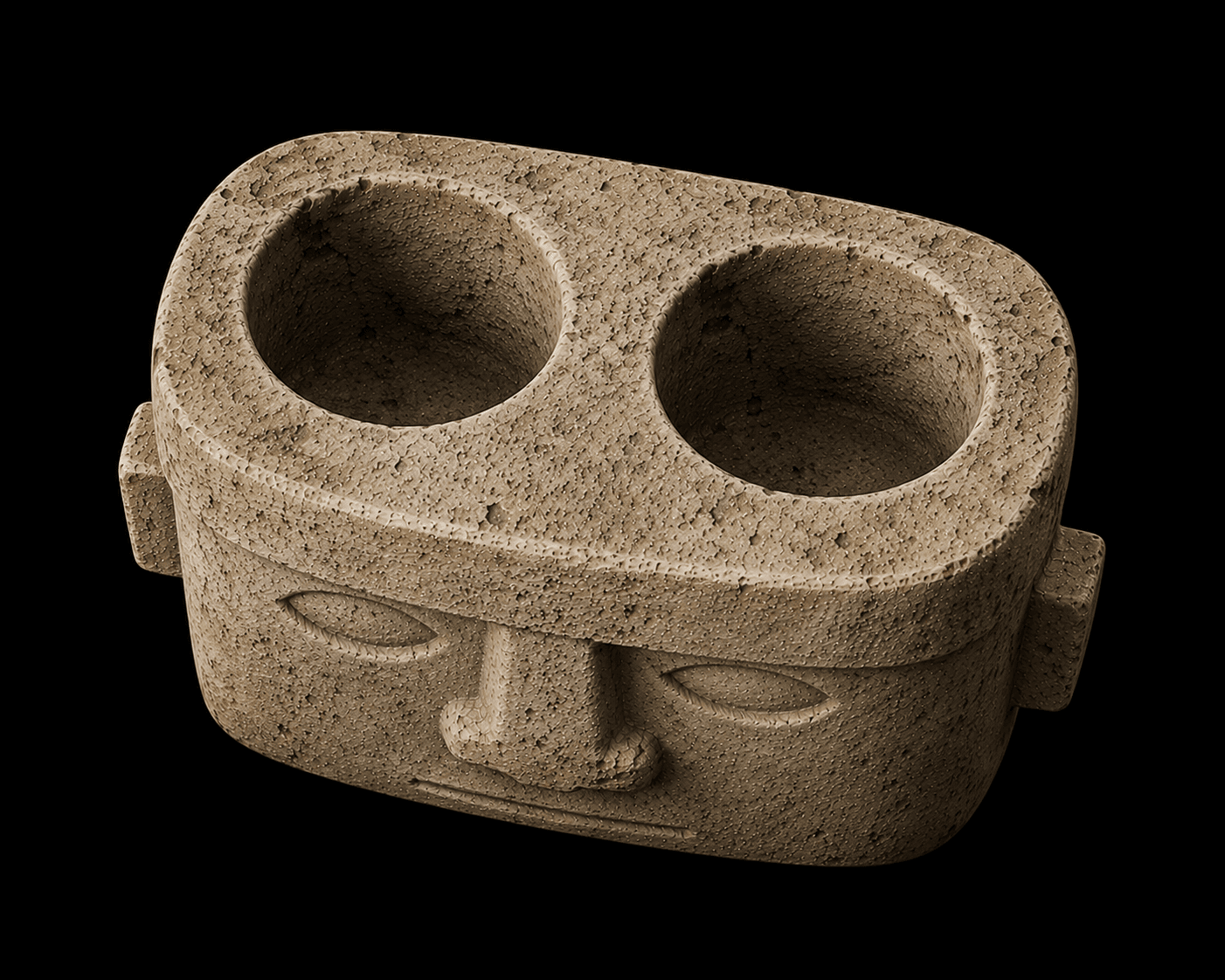
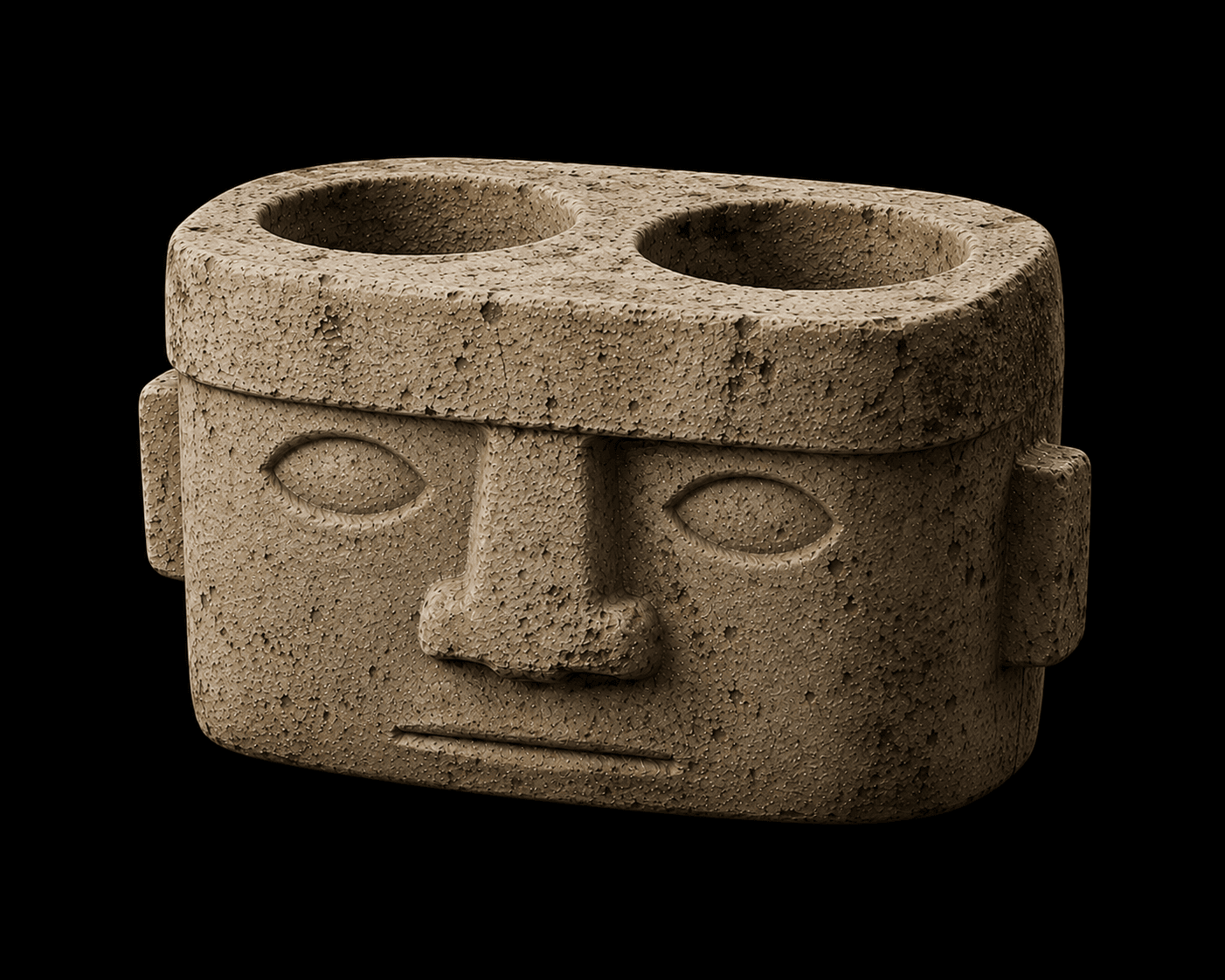
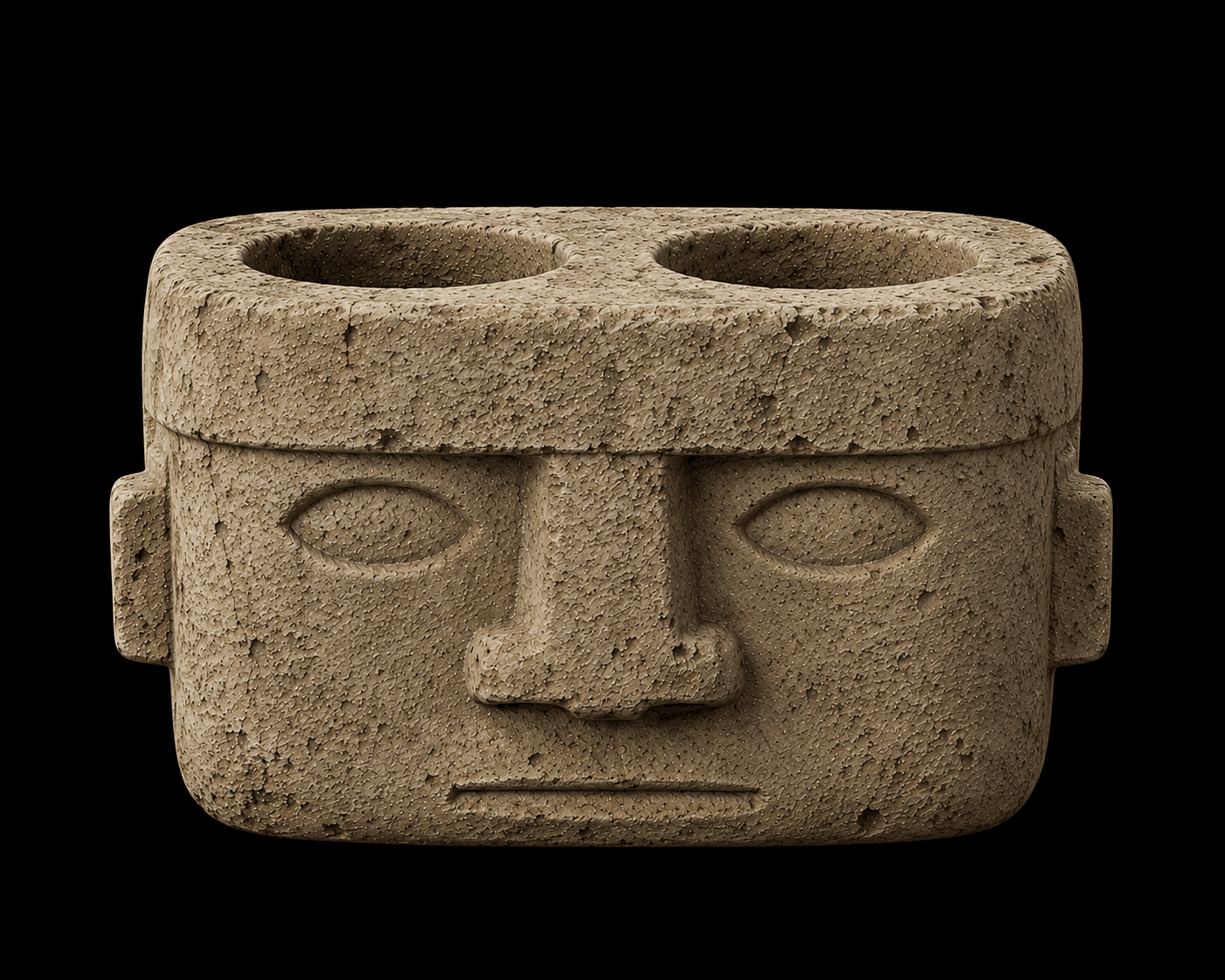
What looked back was not Chaac. Not the long-nosed rain god of the Puuc with his open eyes and his hooked snout that comes apart into thirty mosaic stones. This face had a straight nose, almond eyes closed in the long horizontal sleep of Maya elite portraiture, a small still mouth. Rectangular ear-flares at either side — orejeras — declared it noble. In Maya iconography, no being without ear ornaments is a someone; the absence of orejeras marks an animal, a captive, a thing without sovereignty. The presence of them, even reduced to two small blocks of stone, is a sentence: this one has standing.
The expression was the one carved at Palenque and on the Maize God reliefs: not asleep, not awake. Present. The kind of face the old sculptors gave to ancestors who had crossed once and now stood at the threshold both ways.
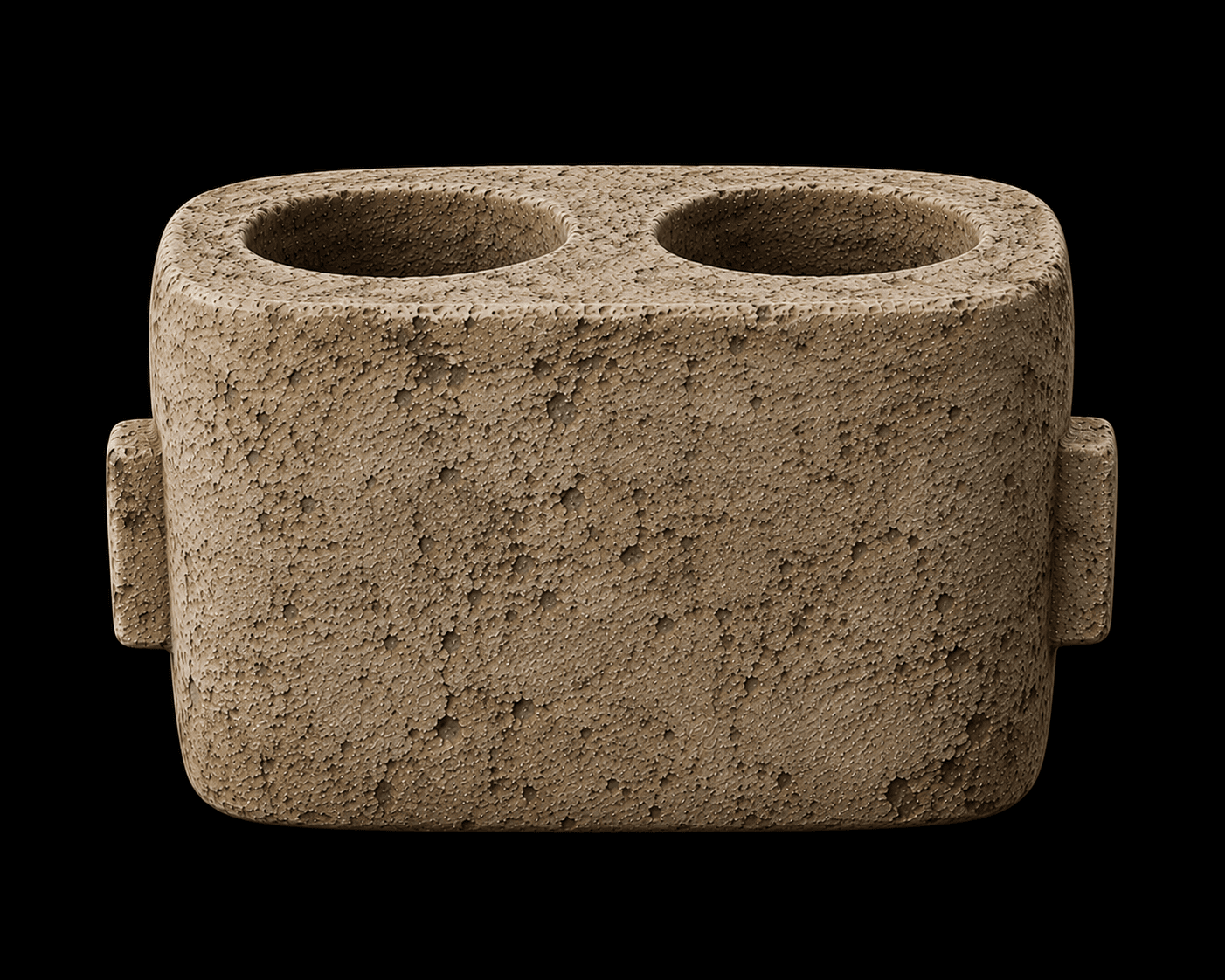
Above the face, where you would expect a headdress, the stone had been hollowed into two smooth round cavities. Two small wells in the crown. I understood instantly what they were for and did not yet understand what they meant.
III. The discovery
A single candle is a sentence. Two candles, side by side, set into stone, flanking a single watching face — that is grammar. The shape of an argument.
The cavities had been carved to a depth and diameter so consistent that a tea light could rest in each without rattling. The artisan had measured them. Whoever set this geometry — and the form repeats across Yucatecan workshops, from Dzityá to Ticul to the small carving villages outside Valladolid — had chosen two with the same deliberateness that a poet chooses a couplet over a line.
You can dismiss this. You can say: it is just a candle holder. Two flames are prettier than one. The market wants symmetry. But Mesoamerica has never set two of anything beside each other without meaning it. Hunahpu and Xbalanqué, the Hero Twins of the Popol Vuh, descend into Xibalba together and rise together at the close of the book — one of them arose as the sun, and the other as the moon. Ometeotl, the older creator-principle, is two lords folded into a single name that means Two-God: Ometecuhtli and Omecíhuatl, male and female balanced on a single axis. The deep grammar of this region's metaphysics is the dyad that rests on a third.
Two flames flanking a face. The formula is older than the stone.
IV. The bridge of two hundred million fibres
Here is what I held in my hand without yet saying it aloud.
The human brain is, in the most literal sense, two brains. The left hemisphere — sequential, linguistic, analytic, addicted to the part. The right — spatial, intuitive, holistic, native to the whole. Roger Sperry won the Nobel in 1981 for showing that when the corpus callosum — the bridge of roughly two hundred million axonal fibres that connects them — is cut, two distinct fields of consciousness emerge in the same skull. One head, two minds, suddenly visible because the cable between them is gone.
Iain McGilchrist, in The Master and His Emissary, argues that Western civilisation has been quietly run by the left hemisphere for centuries while the right — the older, wiser, more attentive of the two — has been demoted to errand-runner. The left is brilliant at the map. The right is the only one of the two that knows there is a territory at all. Real seeing, real meditation, real presence occurs when the two are not at war but at council. When neither dominates. When both are lit, and what they illuminate is not on either side but in the middle.
The carved face on this stone is the corpus callosum given a body.
The two flames are not symbols — they are diagrams. Left hemisphere on one side, right hemisphere on the other, and in the centre, beneath the two candles burning the same colour at the same brightness, the watching face: that older self, the one neither hemisphere alone can produce. The Sanskrit traditions call this witness sākṣin. The Maya, on the other hand, simply carved it.
V. The myth braids the science
Bilateral light is a meditative technology that EMDR clinicians now use under the cool name bilateral stimulation. Eyes track left, then right, then left. A tone in one ear, then the other. The hemispheres are forced to speak across the bridge. Trauma, knotted on one side, loosens when both sides are made to attend to it at once. There is some evidence — not conclusive but persuasive — that the symmetrical use of attention itself is the medicine. Not what you look at. How you look. With both halves.
The Maya of the Yucatán still light candles at the four directions in formal ceremony: red east, white north, black west, yellow south, and a fifth at the centre. But on a smaller, more domestic altar — the one carved for a person's hand, the one I am now holding — the cosmology compresses. Four directions become two flames. The centre becomes a face. The ceremony shrinks until it fits the chest. What survives is the essential gesture: light from both sides, met in the middle, watched by a third thing that is neither side.
In the Popol Vuh, when Hunahpu and Xbalanqué finally rise from Xibalba, the text does not say the brothers ascended together. It says one arose as the sun, and the other as the moon. Two flames. Two hemispheres. One person, completed only by the difference between her halves.
The stone in my hand is a five-thousand-year argument compressed to the size of my palm: you are not one mind. You are two minds in council. The work is the council.
VI. The lighting
Tonight, when the Caribbean has gone black and the cicadas have started their second shift, I will place the stone on the wooden table in the room where Julia is reading. I will set a tea light in each well.
I will light the candle on the right first — the one on the right hand of the face, which is the left candle from the face's own point of view — for the hemisphere that holds language, the part of me that writes this. I will light the left one second, for the older, quieter, image-making hemisphere that knew what the stone meant before language got there.
For a moment, while both flames are still finding their wicks, I will look at the face between them and notice that the face is not lit by either flame alone. The face is lit by their meeting. By the small overlap of light in the middle, where the two cones of warmth touch above the carved brow and become a single, brighter, third thing.
That is the meditation. That is what this object was carved to perform.
A small piece of the Yucatán's vanished ocean, pulled out of the limestone of Dzityá or Ticul or one of the carving villages no map quite reaches by a pair of hands I will never meet — finished with a chisel and a file, dusted with the white powder of its own making, brought to the coast in the back of someone's pickup, set on a table under a palapa roof, and waiting. Waiting for two flames, a quiet evening, and the bridge of two hundred million fibres between the eyes that find it.
I bought it for what felt like nothing.
I will carry it home as if it were a small cathedral.
→ Two cavities. ↔ Two hemispheres. ⇌ One witness.
U K'oh Kib'. The effigy of the candle. The candle of the self.
— Tulum, Quintana Roo