Object Design
Sallenite
A pillar of moonlight in mineral form.
There is a particular kind of light that does not come from a bulb. It comes from inside the stone — refracted, slowed, and carried along microscopic fibres until it reaches the surface and softens into something that looks less like illumination and more like an exhalation. A selenite lamp does not so much shine as breathe light outward. This article is about what selenite actually is, why it glows the way it does, where it comes from, the cultural lineage it carries, and how to live with one without quietly destroying it.
What selenite actually is
Selenite is a crystalline variety of gypsum — chemically, hydrated calcium sulfate, CaSO₄·2H₂O. The "selenite" name refers specifically to the transparent-to-translucent, fibrous or bladed crystalline form. Other gypsum varieties include satin spar (silky fibrous masses, which is what most "selenite" lamps and wands sold on the market actually are), desert rose (rosette aggregates intergrown with sand), and alabaster (the fine-grained massive form sculptors have used since antiquity.
So when you buy a "selenite lamp," you are almost always holding satin spar — a fibrous, parallel-aligned variety of gypsum where individual crystals grow as long needles oriented along a single axis. This distinction matters because the parallel fibre architecture is the entire reason the lamp glows the way it does. The market calls all of it selenite; mineralogists wince politely; everyone moves on.
Hardness sits at 2 on the Mohs scale, which is softer than a fingernail (2.5). You can scratch it with a coin. You can scratch it, in fact, with another piece of selenite. It is also moderately water-soluble — about 2.4 g/L at room temperature. We will return to both of these facts when we talk about care, because they govern almost everything about how to treat the lamp.
Why it glows like that
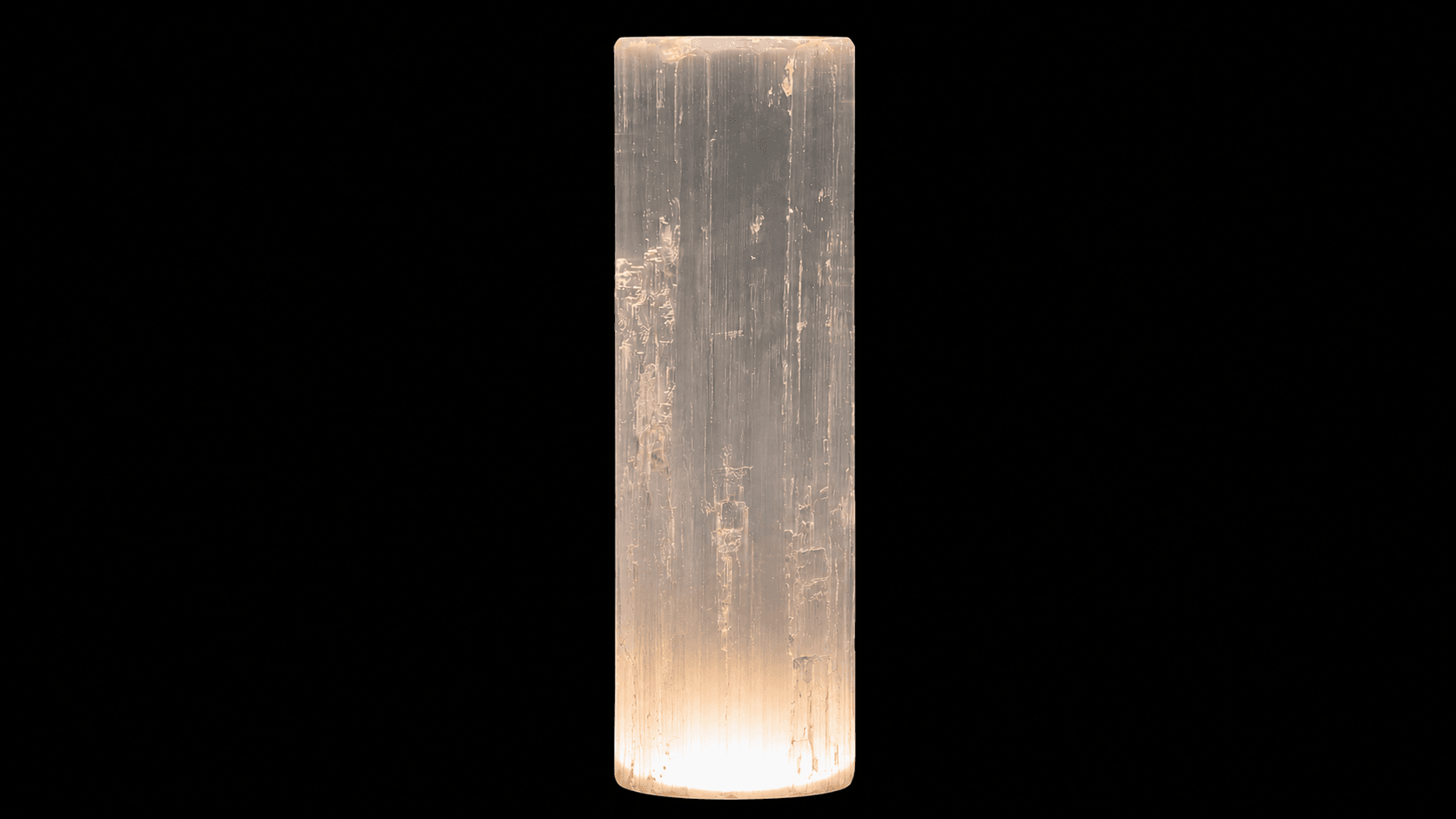
Look closely at the tall pillar form. You can see the vertical striations running the full length of the crystal, like the grain of polished bamboo or a bundle of optical filaments fused into stone. That is not decorative texture. That is the structure doing optical work.
Each of those parallel fibres behaves, in optical terms, like a lossy waveguide. When you place a warm LED at the base of the lamp, light enters the fibre bundle and undergoes repeated internal reflection along the length of each crystal needle. Some light scatters laterally and escapes through the sides — which is why the whole pillar appears self-luminous, not just the tip. The rest continues upward and emerges at the top face, often noticeably brighter than the sides. This is the same principle that makes a bundle of fibre-optic cable carry light around corners; selenite simply does it with mineral instead of drawn silica.
The mineralogical term for this directional sheen is chatoyancy — the same "cat's eye" effect seen in tiger's eye and certain feldspars. In selenite the chatoyancy is unusually pure because the fibre alignment is extraordinarily parallel and the refractive index (~1.52) is close enough to that of the air-filled microvoids between fibres to allow long internal light paths before extinction.
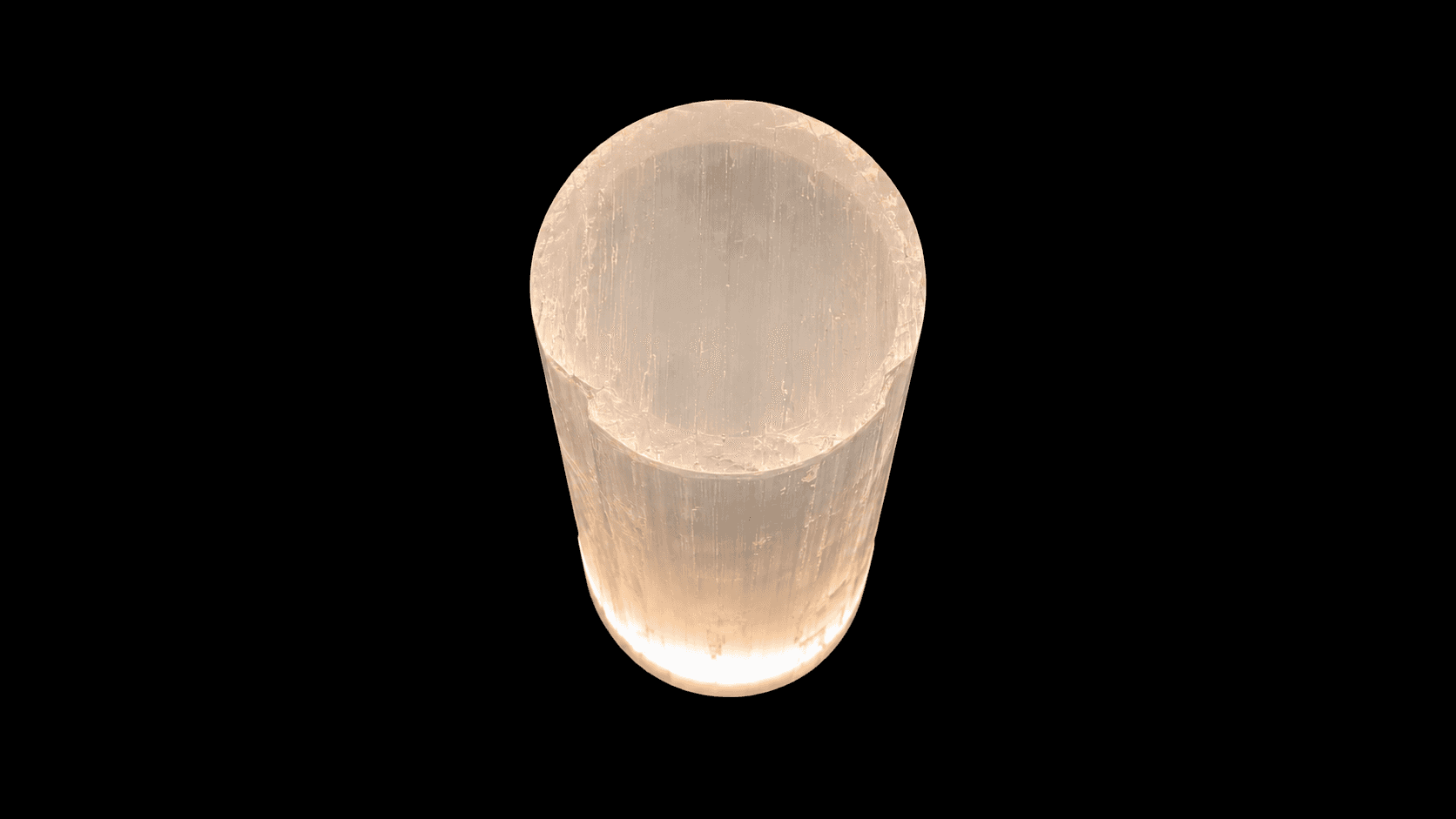
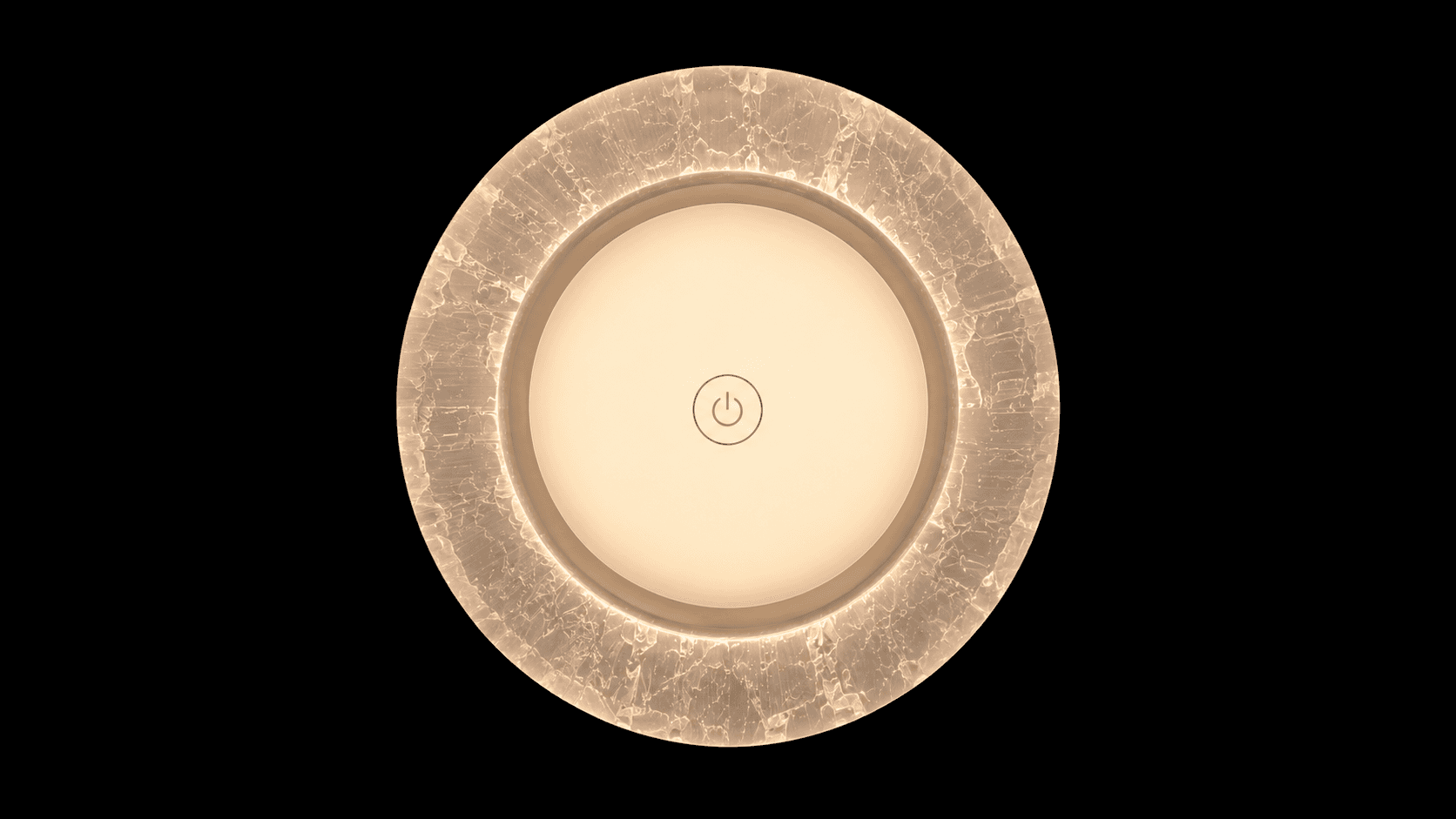
The visual signature is textbook selenite optics: the bottom glow where the LED sits is most intense, the vertical striae scatter softly along the body, and the top face in the overhead view becomes a luminous disc with the surrounding fibrous ring acting as a translucent halo. The top-down view of the power button ringed by glowing fibre ends is essentially a cross-section of the waveguide bundle. Each tiny bright fleck around the rim is the open end of a single fibre channel pouring out its captured photons.
This is the part where a physicist and a wizard agree without quite admitting it: the stone is doing something genuinely beautiful with light, and the mechanism is just as interesting as the metaphor.
The name, and what it carries
"Selenite" comes from the Greek selēnitēs lithos — moon stone, literally — from Selēnē, the goddess of the moon. The Roman naturalist Pliny the Elder used the term in the first century, noting that the stone seemed to wax and wane in brightness with the lunar cycle. That observation is poetic rather than physical (the stone does not actually pulse with the moon), but the association stuck for two thousand years, and it stuck for a reason: held to candlelight or moonlight, the fibrous structure of selenite genuinely does carry and re-emit light in a way no other common mineral quite does. It looks like solidified moonshine. The Greeks were not being whimsical. They were being accurate.
In the contemporary crystal and energy-work tradition, selenite is treated as a clearing and tuning stone — used for cleansing other crystals, for clarifying mental and energetic clutter, and as a kind of household tuning fork for ambient atmosphere. Whether one approaches that frame literally, symbolically, or aesthetically, the practical effect is consistent: putting a glowing fibrous gypsum cylinder in a room changes the room. The light is warmer and more diffuse than any LED panel; the surface texture invites the eye to slow down; the object reads as quiet rather than electronic. The metaphysical reading and the design reading converge on the same outcome — the space gets calmer.
Where it comes from
Most selenite on the global market today is mined in two places: the Atlas Mountains of Morocco, especially the deposits around Boulemane and Khenifra, and the gypsum belts of central Mexico, particularly the famous Cueva de los Cristales (Cave of the Crystals) at Naica, Chihuahua — the latter producing the largest natural selenite crystals ever documented, some over eleven metres long. Mexican selenite is geologically extraordinary because the Naica cavity remained at a near-constant 58°C for hundreds of thousands of years, allowing the crystals to grow undisturbed at a glacially slow rate into structures that effectively cannot exist anywhere else on Earth.
Smaller commercial deposits exist in Madagascar, the United States (notably Oklahoma's selenite hunting fields), Russia, and parts of South America. Most lamp-grade material is Moroccan satin spar, cut and lightly polished into cylinders, towers, and slabs, with a small electrical assembly seated into the base.
If you are in Mexico — and selenite of any provenance interests you — the proximity to Naica and to the broader gypsum geology of the country adds a particular weight to the object on the desk. You are, in a real sense, closer to its source than most owners ever get.
How to live with one without ruining it
Selenite has two vulnerabilities that polite product packaging rarely emphasises strongly enough.
Water dissolves it. Not dramatically, not instantly — but reliably. Wiping a selenite lamp with a damp cloth will, over time, etch the surface, dull the fibre structure, and round off sharp edges. Leaving it on a windowsill where condensation pools will cause visible degradation within months. Cleaning is done dry — a soft brush, a microfibre cloth, compressed air. If something spills on it, blot immediately and let it air-dry; do not rinse.
It is soft enough to mark itself. Stacking selenite pieces against each other in a drawer will produce scratches. So will sliding it across a gritty surface. Treat it the way you would treat a piece of unpolished marble or a delicate ceramic — with the awareness that the surface is participating in the object's beauty and can be lost.
Heat is generally not a concern with modern LED-based lamps because the bulbs run cool, but older incandescent selenite lamps could and did crack their stones over time from thermal cycling. If your lamp gets warm to the touch above body temperature, the lamp is wrong, not the stone.
Direct sunlight will not damage selenite the way it damages amethyst or rose quartz (which can fade), but prolonged UV plus humidity is a worse combination than either factor alone.
A note on design
From a purely product-design vantage point, the lamp form shown in the three images is doing several things right at once. The cylindrical geometry maximises the visible chatoyancy surface — a square or faceted cut would interrupt the vertical fibre lines and break the illusion that the stone itself is glowing. The black background in the product photography is not just dramatic; it is necessary, because selenite's whole optical character is low-contrast warm against deep void, and any ambient light in the frame washes out the effect. The single warm LED beneath the disc, the recessed power button, the absence of visible seams or fasteners — these all work to remove the appliance signal and let the stone signal dominate. You are meant to read the object as a piece of mineral that happens to light up, not as a lamp that happens to be made of stone. That hierarchy is the entire design intent, and the three photographs telegraph it cleanly: side profile, full pillar, overhead. Form, length, function. Nothing else in the frame.
For anyone designing in adjacent territory — interior objects, ritual hardware, ambient computing artefacts, anything where the goal is to make technology feel like matter rather than device — selenite is one of the most instructive case studies available. It is a working demonstration that the most convincing UX of all is when the user forgets there is a U or an X.
A small closing observation
The selenite lamp is one of the few household objects that successfully holds three frames at once without contradiction. To a mineralogist it is a parallel-fibred gypsum specimen with measurable optical properties. To a designer it is a quiet exercise in letting material do the work. To anyone working with energy, intention, or atmosphere, it is a tuned object — a moon held still on a shelf.
All three frames point at the same stone. That is, in the end, the thing worth noticing about it.